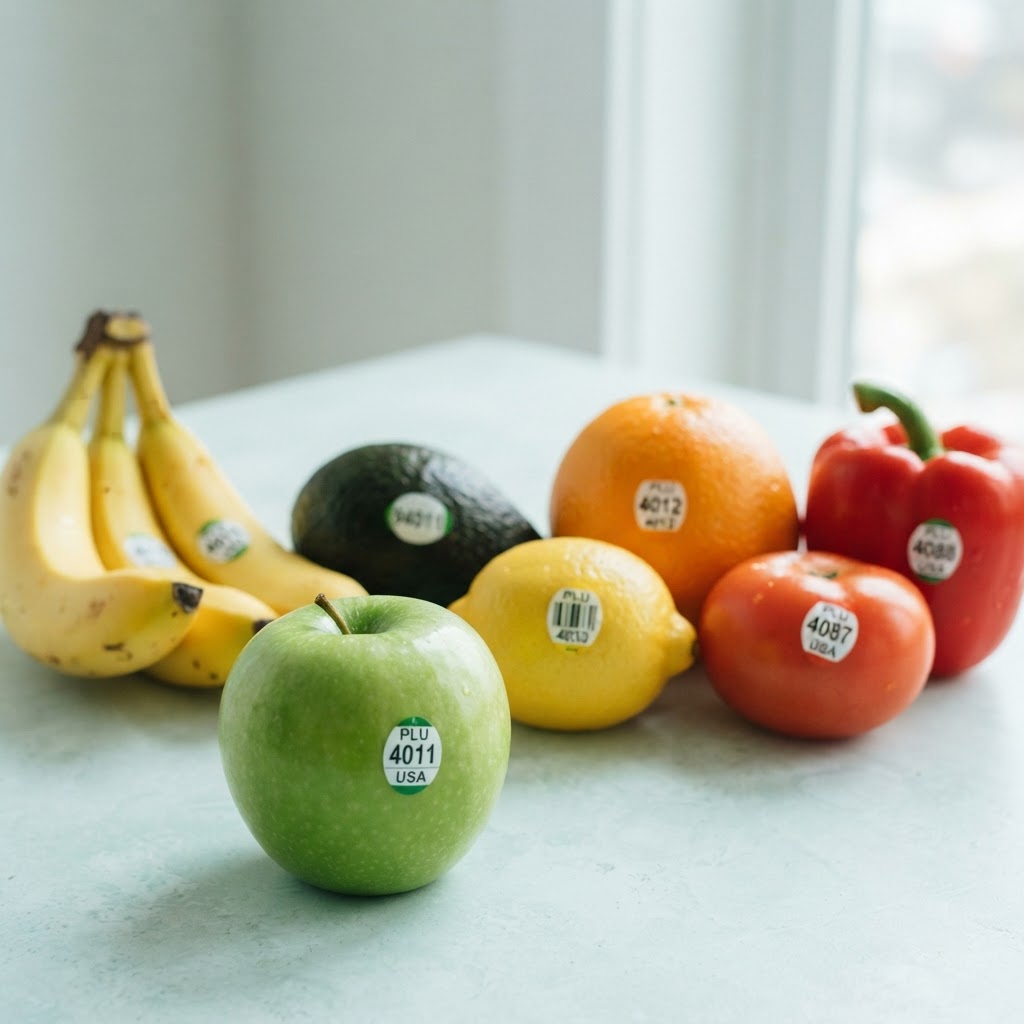
Decode Any Food Label
in 3 Seconds
From the little sticker on an apple to the numbers hidden in an ingredients list — food labels carry two codes every shopper should know. Learn the PLU system (is it organic, conventional, or GMO?) and the INS system (what do those E-numbers mean?) once, and read any label anywhere in the world.
Produce Stickers
PLU Codes — Is It Organic, Conventional, or GMO?
That little sticker on your apple or banana carries a Price Look-Up (PLU) code. Its prefix tells you exactly how the produce was grown. Enter the code below to decode it instantly.
PLU codes are set by the International Federation for Produce Standards (IFPS). They are 4 or 5 digits long. The number of digits — and the first digit when there are five — tells you the growing method. Learn the three prefixes below and you can read any produce sticker in seconds.
Look Up a PLU Code
Try the banana code , or its organic version .
4 digits (3000–4999)
Grown with standard farming methods — may include synthetic fertilizers and pesticides.
Example: 4011 = Banana
5 digits starting with 9 (93000–94999)
Certified organic — produced without synthetic pesticides, fertilizers, or GMOs.
Example: 94011 = Organic Banana
5 digits starting with 8 (84000–84999)
Originally assigned to genetically engineered produce. Rarely used today — not a reliable GMO indicator.
Example: 84011 = GMO-designated Banana (theoretical)
A note on GMOs: The "8" prefix was created to flag genetically engineered produce, but retailers rarely used it. Today an "8" does not reliably mean GMO, and the absence of an "8" does not guarantee non-GMO. For GMO status, look for certified labels such as USDA Organic or the Non-GMO Project Verified seal.
Count the digits on the sticker — 4 or 5.
If it's 5 digits, check the first number: 9 = organic, 8 = GMO-designated.
A 4-digit code (3000–4999) means conventionally grown.
Source: International Federation for Produce Standards (IFPS) — PLU Codes. Educational summary only; not medical advice.
Label Literacy
The INS Number System
The International Numbering System (INS) is set by the Codex Alimentarius — a global food-standard program run by the WHO and FAO. Every food additive gets a number. Learn the ranges once and you can read any label in the world.
In Europe these numbers appear with an "E" prefix (e.g. E300). Outside Europe the same numbers appear without it (e.g. INS 300). The number tells you the family the additive belongs to — and that's all you need to remember to make smarter choices.
Spot the number on the ingredients list (e.g. 'E250').
Look at the hundreds digit — that tells you the family (2 = preservative).
Decide: is that family one you want more or less of in your body?
How We Grade Safety
Verdicts cross-reference three bodies. EFSA (European Food Safety Authority) re-evaluates each additive and sets an Acceptable Daily Intake (ADI). WHO/JECFA sets global ADIs, and IARC (a WHO agency) classifies carcinogenicity. BRCGS (Global Standard for Food Safety) governs labelling, allergen control, and supplier transparency — it does not assess individual additive toxicity, so it is cited here for labelling and allergen relevance. Verdicts are general guidance; individual sensitivity varies.
Source: Codex Alimentarius (FAO/WHO) — Class Names and the International Numbering System for Food Additives (CXS 192-1995). Educational summary only; not medical advice.
Meat Labels
Cultivated vs. Natural Meat
Lab-grown (cultivated) meat and natural (conventional) meat differ in how they are produced, labeled, and structured. Here is what to look for on a label.
Since 2019, the FDA and USDA-FSIS share oversight: the FDA regulates cell collection and the pre-harvest phase, while USDA-FSIS inspects the harvesting, processing, and labeling. In 2023 the first grants of inspection were issued for “cell-cultivated chicken.” Labels must use terms like “cell-cultured,” “cell-cultivated,” or “cultivated” — “lab-grown” is a media term, not an approved label word.
Natural (Conventional) Meat
Origin
Raised and slaughtered on farms through traditional animal husbandry.
Labeling
Uses standard terms — “beef,” “chicken,” “pork.” No special qualifier required.
Texture
Complex muscle fibers and fat marbling formed through natural movement and growth.
Nutrition
Natural fat profile that varies by cut and the animal's diet.
Cultivated (Cell-Cultured) Meat
Origin
Grown from animal stem cells in large steel bioreactors — no live animal is slaughtered.
Labeling
USDA-FSIS requires “cell-cultured,” “cell-cultivated,” or “cultivated” (not “lab-grown”); every label is pre-approved. Some states restrict or ban it.
Texture
Often lacks natural marbling and complex muscle structure unless 3D printing or scaffolding is used; usually sold as nuggets, strips, patties, or burgers.
Nutrition
Can be customized (e.g. lower saturated fat) and needs no antibiotics; nutritional equivalence to conventional meat is still being studied.
How to Spot It on a Label
- Look for “cell-cultured,” “cell-cultivated,” or “cultivated chicken/beef” — these indicate cultivated meat.
- If a label simply says “chicken” or “beef” with no such qualifier, it is conventional meat.
- The industry prefers “cultivated”; “lab-grown” is not an approved packaging term.
Sources: USDA-FSIS — “Human Food Made with Cultured Animal Cells”; FDA — Human Food Made from Cultured Animal Cells; Congressional Research Service — “Cell-Cultivated Meat: An Overview” (R47697). Educational summary only; not medical advice.
Health & Medical Disclaimer
Last Updated: November 2026
The information, content, and materials provided on this page by BodyWise360 — including but not limited to nutrition tips, dietary guidance, macro calculations, hydration recommendations, and supplement or ingredient information — are intended solely for general educational and informational purposes.
Nothing on this page constitutes medical advice, diagnosis, or treatment. The content is not a substitute for professional medical advice, guidance from a registered dietitian, licensed nutritionist, or any other qualified healthcare provider. Always seek the advice of your physician or other qualified health professional before making any changes to your diet, nutrition plan, or lifestyle.
BodyWise360 and its representatives expressly disclaim all liability for any adverse effects, injuries, losses, or damages of any kind arising directly or indirectly from the use or misuse of any information presented on this page. Individual nutritional needs vary significantly based on age, sex, health status, medical history, fitness level, and other personal factors.
Macro and hydration calculations provided on this page are estimates based on widely accepted wellness formulas and are provided as a general starting point only. These results do not account for specific medical conditions, medications, allergies, or individual metabolic differences. Consult a healthcare provider before following any calculated targets.
References to food ingredients, supplements, or substances described as potentially harmful are based on publicly available research and are shared for educational awareness. BodyWise360 makes no warranties or representations regarding the accuracy, completeness, or timeliness of such research, as nutritional science continues to evolve.
By using this page, you acknowledge that you have read and understood this disclaimer and agree that BodyWise360, its owner, coaches, and affiliates shall not be held liable for any decisions made based on the information provided herein. If you are experiencing a medical emergency, call 911 or contact your local emergency services immediately.
We Use Cookies & Session Storage
BodyWise360 uses cookies and session storage to enhance your experience (e.g., remembering your preferences). We do not sell your data or track you for advertising. By clicking Accept, you consent to our use of these technologies as described in our .